Welcome To The Country Historian
The Curator of Country Music - Preserving History, Honoring its Legacy, Inspiring the Future


The Rockabilly Era 1953-1959
Rockabilly didn’t begin as a genre with a name. It began as a feeling—an electric jolt running through the American South in the early 1950s. Young musicians were raised on the country and “hillbilly” music of their parents, but late at night they tuned their radios to far‑off stations spilling rhythm & blues, jump blues, and boogie‑woogie across the airwaves. In that collision of twang and groove, something new sparked to life. It was raw, fast, and rebellious—the sound of a generation itching to break free from the quiet conformity of post‑war America.
Yet in 1953, the music industry still lived inside tidy boxes. Billboard had Country & Western, Rhythm & Blues, and Pop charts, each with its own audience and gatekeepers. But there was no Rock ’n’ Roll chart, because—officially—rock ’n’ roll didn’t exist. The sound was bubbling up in Southern bars, barn dances, and late‑night radio shows, but the industry had no category for it. And when the industry has no category, it forces the music into the closest box it can find.
That box was country.
Rockabilly—this wild fusion of hillbilly twang and R&B rhythm—was born in the South, played by Southern kids, and performed on Southern stages like the Louisiana Hayride, the Big D Jamboree, and countless barn dances. The musicians wore country clothes, used country instruments, and came from country towns. So when their records started selling, labels had only one place to send them: the Country & Western charts.
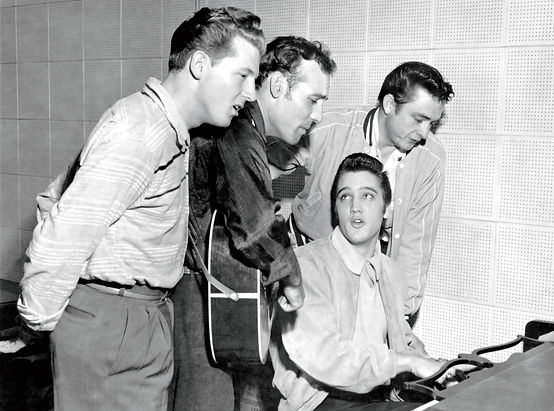
By 1953–1954, the spark caught fire at Sun Records in Memphis. A shy truck driver named Elvis Presley stepped into the studio and fused country vocals with R&B rhythms on “That’s All Right,” creating a sound no one had heard before. Around him, Carl Perkins, Johnny Cash, and Jerry Lee Lewis were shaping the same explosive mix. None of them realized it yet, but they were defining one of the earliest forms of rock and roll.
Because Elvis played the Hayride, toured with country acts, and came from the same circuit as Hank Snow and Webb Pierce, his early singles were automatically filed under country. Not because they sounded country—but because there was nowhere else to put them. For a brief moment, Elvis, Perkins, Cash, and Lewis were all charting side‑by‑side as “country artists,” even though their music was exploding into something entirely new. Rockabilly became a subgenre of country only by default, not by design. The industry simply didn’t have the language—or the courage—to admit a revolution was happening.
Meanwhile, the sound itself was unmistakable. Hollow‑body electric guitars slapped and echoed. Upright basses thumped like heartbeat and percussion rolled into one. Drums were sparse but driving. Vocals were drenched in echo—hiccuping, shouting, or crooning with a swagger that felt brand new. It was music built for motion: cars on the highway, feet on the dance floor, dreams racing ahead faster than the world could catch them.
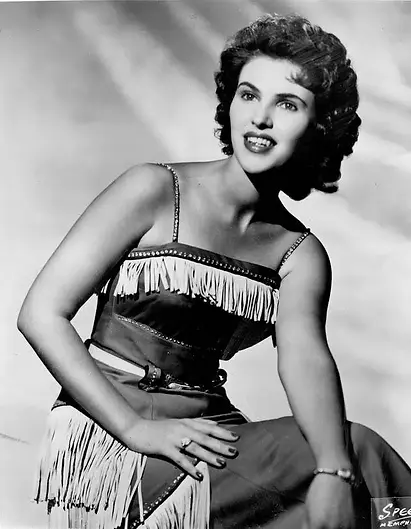
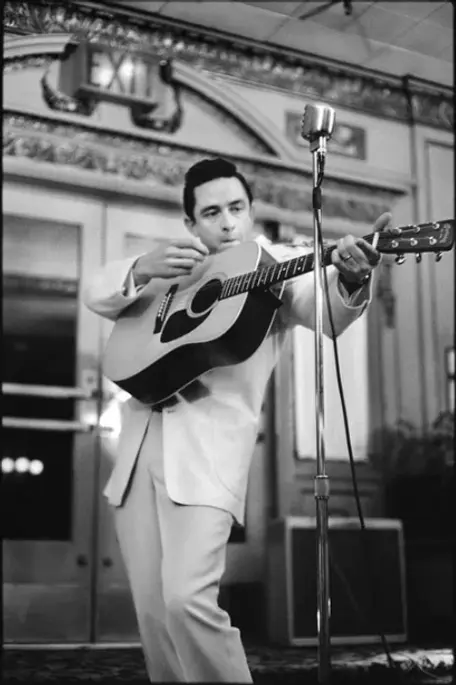
Between 1953 and 1959, a wave of artists pushed rockabilly into the national spotlight. Carl Perkins delivered “Blue Suede Shoes,” a perfect blend of country storytelling and rock rhythm. Jerry Lee Lewis pounded the piano like it owed him money, turning “Whole Lotta Shakin’ Goin’ On” into a cultural earthquake. Johnny Cash brought his steady boom‑chicka‑boom rhythm. Buddy Holly added pop sensibility and vocal hiccups that became iconic. Gene Vincent and His Blue Caps gave the world “Be‑Bop‑A‑Lula,” and Wanda Jackson, the fierce “Queen of Rockabilly,” proved the genre had room for a woman who could out‑swagger any man on stage.
Then came 1955–1956. The youthquake hit. Radio stations began using the phrase “rock and roll,” record stores created new bins, and Billboard finally introduced dedicated Rock & Roll charts. The moment those charts appeared, Elvis vanished from the country listings almost overnight. His songs—“Heartbreak Hotel,” “Hound Dog,” “Don’t Be Cruel”—were no longer treated as country crossovers. They were recognized for what they truly were: the birth of a new genre.
And with that shift, history rewrote itself. Elvis’ early Sun singles, once considered country by necessity, became reclassified as rock ’n’ roll classics. The same industry that had squeezed him into the country charts now held him up as the King of Rock ’n’ Roll. Rockabilly, once a nameless hybrid, became the spark that lit the fuse.
In the end, the charts didn’t define the music—the music forced the charts to evolve. Rockabilly broke the boxes, and rock ’n’ roll rose from the pieces, loud, fast, and unforgettable.